

INVASIVE PLANTS
The six most common invasives in Laurel Park
What each one is, how to recognize it, and when and how to control it. If you are not sure what you have, send us a photo.
For specific management recommendations, this site provides links to external sources such as NC Extension Service websites.
SELECT A SPECIES
Japanese knotweed · Kudzu · English Ivy · Oriental Bittersweet · Miscanthus · Japanese stiltgrass
Japanese Knotweed
Fallopia japonica · perennial, spread by rhizome fragments, stem cuttings, minimal spread by seed.
Knotweed forms dense stands of hollow, bamboo-like stems that shade out everything beneath them and are notoriously difficult to remove once established. It re-sprouts readily from small fragments of foliage or rhizome, which is why the usual instinct — dig it out or mow it down — makes the problem worse rather than better.
CONTROL TIMING & METHODS
Digging and mowing are not recommended; both fragment the rhizome and stems, spreading the infestation. Target the root system instead, using foliar herbicide, with late summer to early fall applications being the most effective as the plant moves energy into its roots. Expect to follow up over multiple seasons, and dispose of all cut material properly — never compost it or set it out at the curb.
NC Extension Service (Henderson County Office) has a guide to identification and control at this website.
See photos at our Photo Guide to aid in identification
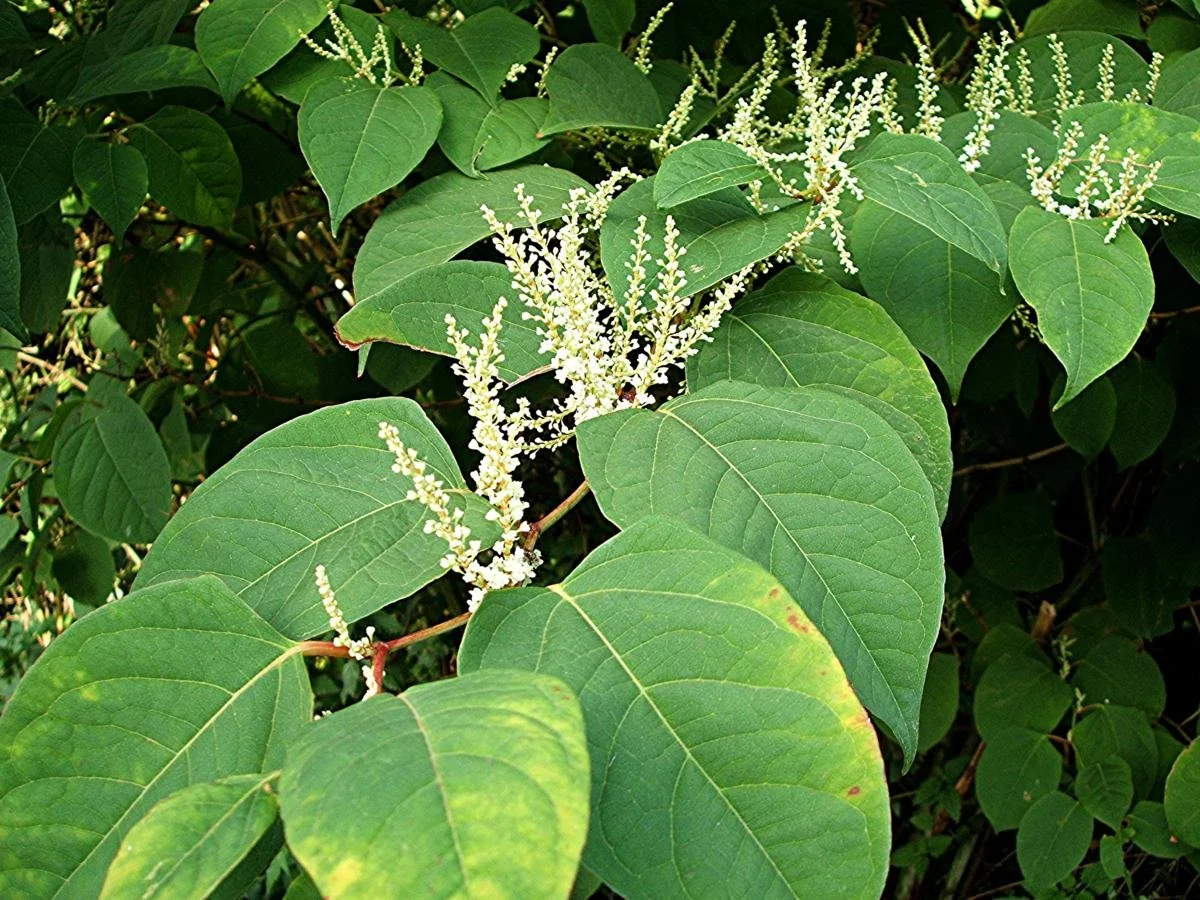
Japanese Knotweed flowering in late summer. Laurel Park, NC.
Kudzu
Pueraria montana · perennial vine, regrows from its root crown or fragments of root crown. Nodes on vines can root in soil, forming a new plant.
Kudzu climbs and blankets whatever it reaches, and a mature infestation can bury standing trees under its own weight. Unlike knotweed, it does not spread from scattered root fragments — it regrows from the root crown, and its real spread risk is vine layering, where nodes root wherever a cut vine touches soil.
CONTROL TIMING & METHODS
Because the crown is the target, mechanical removal can work on young or isolated plants when the entire crown is taken out. On established patches, cut the vines back and follow with a foliar or cut-stem herbicide application on the exposed cut area, close to the soil. Check that cut vines are not left lying on soil where the nodes can root, and monitor the site for several seasons. Also, care must be taken not to fragment the crown root, or fragments can re-infest.
NC Extension Service has a comprehensive guide to control at this website.
See photos at our Photo Guide to aid in identification

Kudzu Flowering in Late Summer
English Ivy
Hedera helix · perennial, roots wherever stems touch soil
Still widely sold as a groundcover, English ivy does two kinds of damage. On the ground it forms a dense mat that excludes native ground-layer plants and tree seedlings. When it climbs, it adds weight and wind resistance to a tree while shading the bark, stressing the host and eventually killing it.
CONTROL TIMING & METHODS
Start with the climbing vines. Cut a clear band around the trunk at chest height and again at the base, then leave the upper growth to die in place rather than pulling it down and stripping bark. On the ground, pull or cut and treat the cut stems, working outward from the edges of the patch. Because ivy roots at every point where a stem contacts soil, success depends on repeat visits rather than one clearing.
NC Extension Service has a comprehensive guide to control at this website.
See photos at our Photo Guide to aid in identification
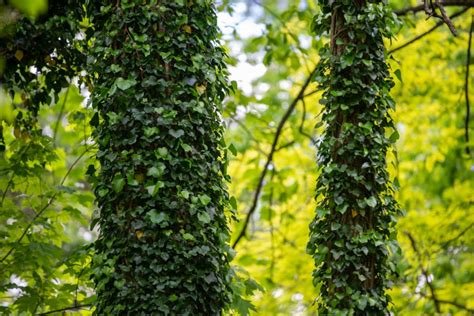
English Ivy Climbing Trees
Oriental Bittersweet
Celastrus orbiculatus · perennial woody vine, spreads by seed or vegetatively. The most destructive of the six for mature trees. Bittersweet twines tightly around trunks and limbs, girdling them as it thickens and eventually toppling the host. Birds spread the seed widely, so new plants appear far from any existing infestation, and it also spreads by root fragments.
Be careful not to confuse this with our native American bittersweet (Celastrus scandens), a similar-looking but non-invasive species. If you're not sure which one you're looking at, ask before removing it. To help distinguish between the two species visit this source.
CONTROL TIMING & METHODS
Because it re-infests from seed, bittersweet needs a combined strategy: prevent seed set and attack the root system in the same season. Cut climbing vines to free the tree, then treat the cut stems — cutting alone triggers dense resprouting. Late summer into early fall is the effective window for foliar treatment. Expect multi-year follow-up, and watch for new bird-dispersed seedlings well away from the original patch.
NC Extension Service has a comprehensive guide to control at this website.
See photos at our Photo Guide to aid in identification
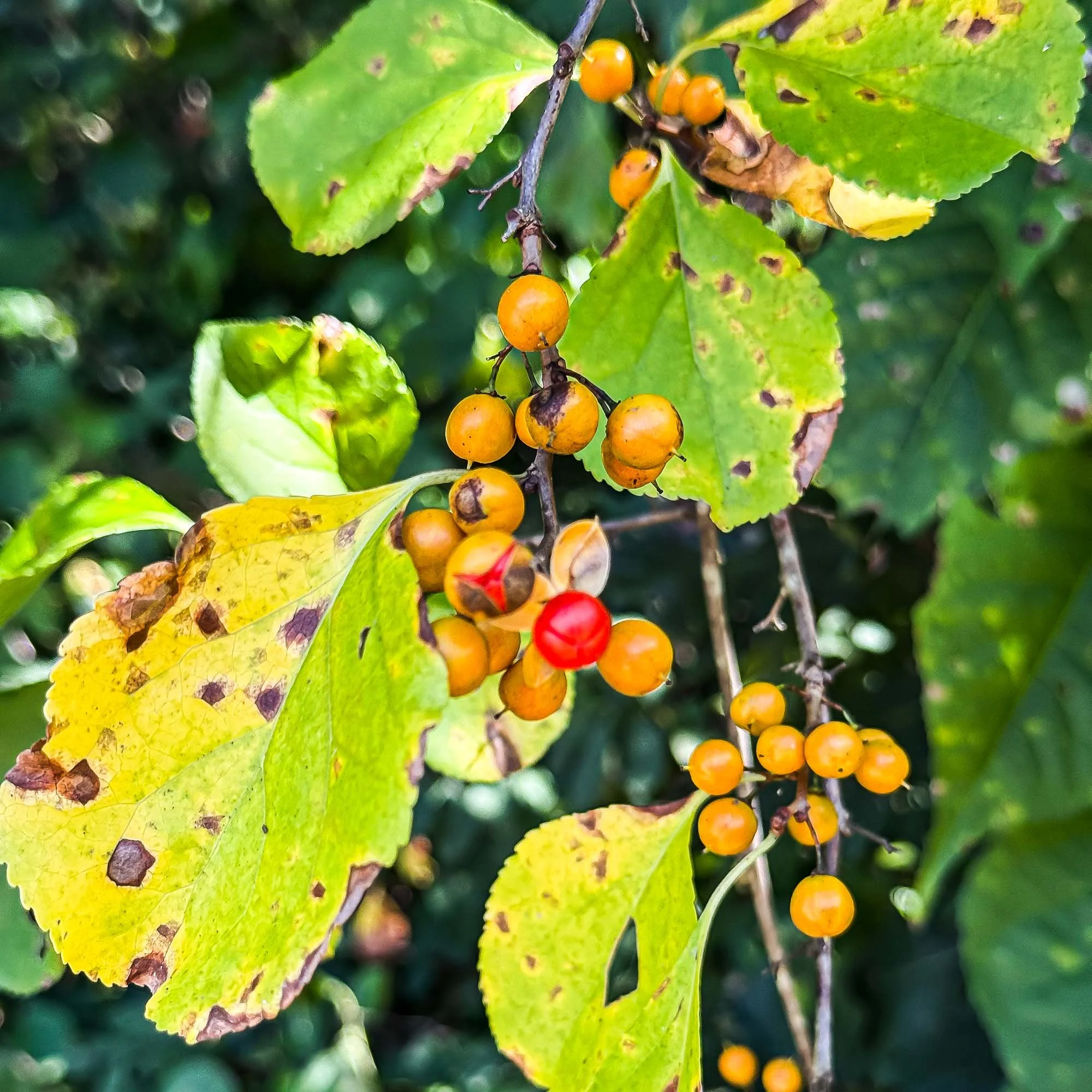
Berries of O. Bittersweet - mid-September
Miscanthus (Chinese silver grass)
Miscanthus sinensis · perennial grass, spreads bu seed and rhizomes.
An ornamental grass that escaped cultivation and is still sold in garden centers. It produces heavy seed loads that carry on the wind, and the clumps expand by rhizome, so a single landscape planting can seed roadsides and open ground for years. Dry winter stands also carry fire readily.
CONTROL TIMING & METHODS
he first priority is preventing seed set — cut the clumps before the seed heads mature. Because it also spreads by rhizome, cutting alone will not finish it: pair cutting with a foliar herbicide application targeting the root system, and treat any satellite clumps that have seeded out from the parent planting. If it is growing in your landscape as an ornamental, replacing it with a native grass ends the problem at its source.
NC Extension Service has a comprehensive guide to control at this website.
See photos at our Photo Guide to aid in identification
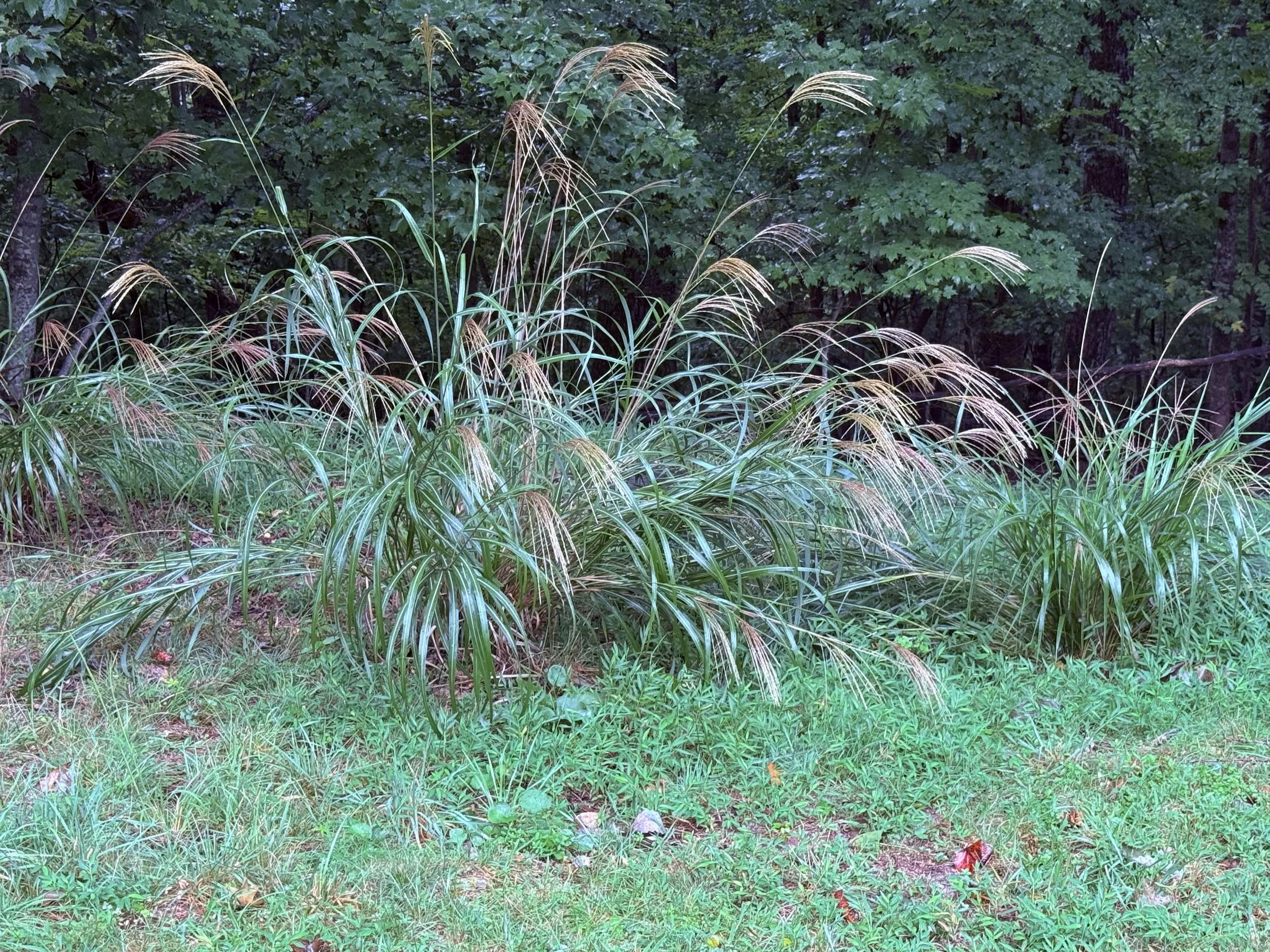
Miscanthus Flowering in Late Summer
Japanese Stiltgrass
Microstegium vimineum · annual, seed only.
Although it is easily controlled, it has a large and expanding footprint in Laurel Park. Every plant you see grew from seed this year. It forms sprawling mats along trails, roadsides, and moist woodland floors, crowding out native ground-layer seedlings, and it thrives in exactly the disturbed, partly shaded ground that is common along Laurel Park's roads and driveways. Stiltgrass will die with the first frost, but seed in the seed bank will re-infest the area the following Spring.
CONTROL TIMING & METHODS
Success is entirely about preventing seed set each year. Pull, mow or spray before it flowers — timing matters far more than method here.
A soil-active herbicide in late winter can also draw down the seed bank. Because seed persists in the soil for several years, repeat the same treatment on the same ground for several seasons before expecting it to stay clear.NC Extension Service has a comprehensive guide to control at this website.
See photos at our Photo Guide to aid in identification
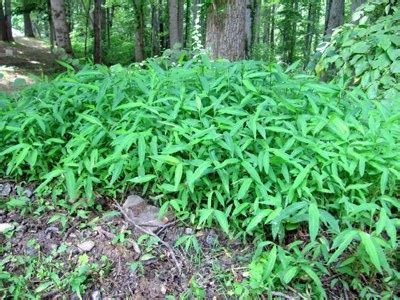
Japanese Stiltgrass in Late Summer
This site does not recommend or endorse the use of any specific herbicide product. Always read, understand, and follow all label instructions before using any herbicide
GET IN TOUCH
BY EMAIL
BY PHONE
Laurel Park Town Hall — (828) 693-4840
IN PERSON
Invasive Plant Workshop — Monday, October 12, 6–8 pm, First Congregational Church
WHO WE ARE
Native Plant Stewardship Committee of Laurel Park